In short
Reviewing your day helps you settle before sleep, keep things in proportion and notice what mattered. The trap is the blank page. You can do it by hand with three questions, or let Daybard replay your day from your calendar: you relive the moments, you don't write them up.
You get into bed with a full head. The day flew by and you're not quite sure what was in it. That's why so many people look for a way to review their day at night: to settle down before sleep, keep a record, and remind themselves the day was worth something, even when it was heavy.
Why an evening review makes a difference
Going back over your day isn't a calendar exercise. It's the moment you turn a string of things that happened to you into a story you understand. A few effects come up again and again:
- A calmer head at bedtime. What's been put down stops looping.
- A day that was less of a failure than it felt. There's almost always a small win you didn't notice at the time.
- Weeks that stop blurring together. Without a record, days look alike; a nightly ritual gives them some shape again.
The manual version: three questions, two minutes
You don't need an app to start. In bed, screen-free if you prefer, go back through your day in order and ask yourself:
- What happened? The thread of the day, from waking up to bedtime. Your calendar helps you get the order right.
- What was the hardest moment, and how did I get through it? Not to judge yourself: to acknowledge what you did.
- What do I want to keep? Something your kid said, a coffee in the sun, a task finally done.
If you keep this up in a notebook, great. Most people drop it after a few nights, though, for a simple reason.
The real obstacle: the blank page
Nearly every end-of-day method asks you to write: three gratitudes, a page of reflection, "what did you learn today?". It looks lovely on paper. At 11pm, tired, facing an empty page, people give up fast.
The idea behind Daybard is to remove that step. Your calendar already holds the thread of your day. It just needs to be handed back to you in a form you actually want to open, leaving you only to choose how each moment ends.
The Daybard method, in 5 minutes in bed
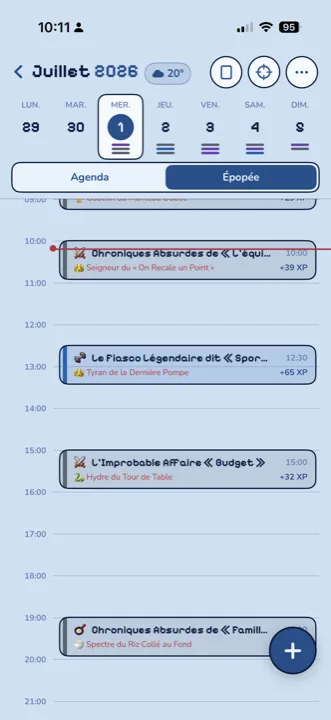
Daybard reads your calendar (iPhone and Mac) and turns each moment into a quest. At night, on iPhone, it opens the grimoire: your day replayed, chapter by chapter.
- Live your day as usual. Meetings, school, workouts, family life: whatever's in your calendar is already captured. Something unplanned? One sentence adds it.
- At night, open the grimoire. The app greets you with today's chapters, one per moment.
- Relive each moment. The card tells it in your favorite style and offers three paths: noble, wise or heroic. None is punished: it's a replay, not an exam.
- Face the boss of the day. The toughest moment of your day becomes tonight's boss. Beating it closes the day.
- Collect, then sleep. XP, gold, loot. One day reward per day, then the grimoire closes.
What if your day was empty, or too heavy?
A day with no events isn't a day with nothing in it. Add two or three moments in one sentence ("kids' bath time", "call with mom") and they join the grimoire.
On the other hand, a packed day can feel heavy to look back on. That's where tone helps: replaying a painful meeting in comic or fairy-tale mode doesn't deny that it was painful, it just gives you a bit of distance. Sleep is part of the game too: if you allow Health access, a short night shows up in your hero's energy the next day, like in real life.
Replay rather than write
A journal asks you to produce content. Daybard hands it to you; all you do is react. It's the difference between writing a page and watching an episode of your own life. The ritual sticks because it's short and guided, and because it ends on a reward instead of a list of what's left to do.
Miss one to three evenings and the Vigil lets you catch up in a short version, with your streak stitched back together. The goal isn't perfection. It's wanting to come back tomorrow.
Start your evening ritual tonight
Free download, no account. Your day is waiting in the grimoire.